Complete Guide to Face Recognition Access Control
Cards get shared, lent to colleagues, or lost. PINs get read over a shoulder. Every reissued credential costs administrative time, and none of these methods proves who actually walked through the door. Face recognition access control addresses the root problem: it ties entry to the person rather than to an object they carry. When the verification module is built into the gate, one glance at the lane releases the barrier — no badge to tap, no separate reader pedestal, no token to administer.
This guide is written for purchasing managers and retailers evaluating face recognition access control for commercial, industrial, and public-infrastructure projects. It covers how face verification works in a turnstile lane, the selection criteria that matter, HPT's listed turnstile-integrated configuration (model AG-PX48141402 with a face recognition module), and the risks that sink biometric projects. Every figure comes from the manufacturer's listed product data. Where a decision-critical number is not published — matching accuracy, liveness handling, template storage — the guide names it and tells you what to demand in writing.
What Face Recognition Access Control Is
Face recognition verifies identity by comparing a live capture of a person's face against enrolled reference data, then releasing the door or gate if the comparison passes. In a lane, the sequence is: person approaches, camera captures, system compares, barrier releases for an authorized match, event is logged. There is no credential to carry, borrow, or forget, and identity is checked on every passage rather than at issuance.
Standalone Terminals versus Turnstile-Integrated Verification
Standalone face terminals mount beside a door and switch an electric lock. Turnstile-integrated verification — the configuration HPT lists — fits the face recognition module as a peripheral on the gate itself, so reader and barrier ship as one assembly: one cabinet, one wiring run, no gap between the verification point and the barrier. On this full-height configuration, verification sits in front of a rotating rotor, so an authorized face admits exactly one person and a tailgater meets closed hardware.
Where Face Verification Fits
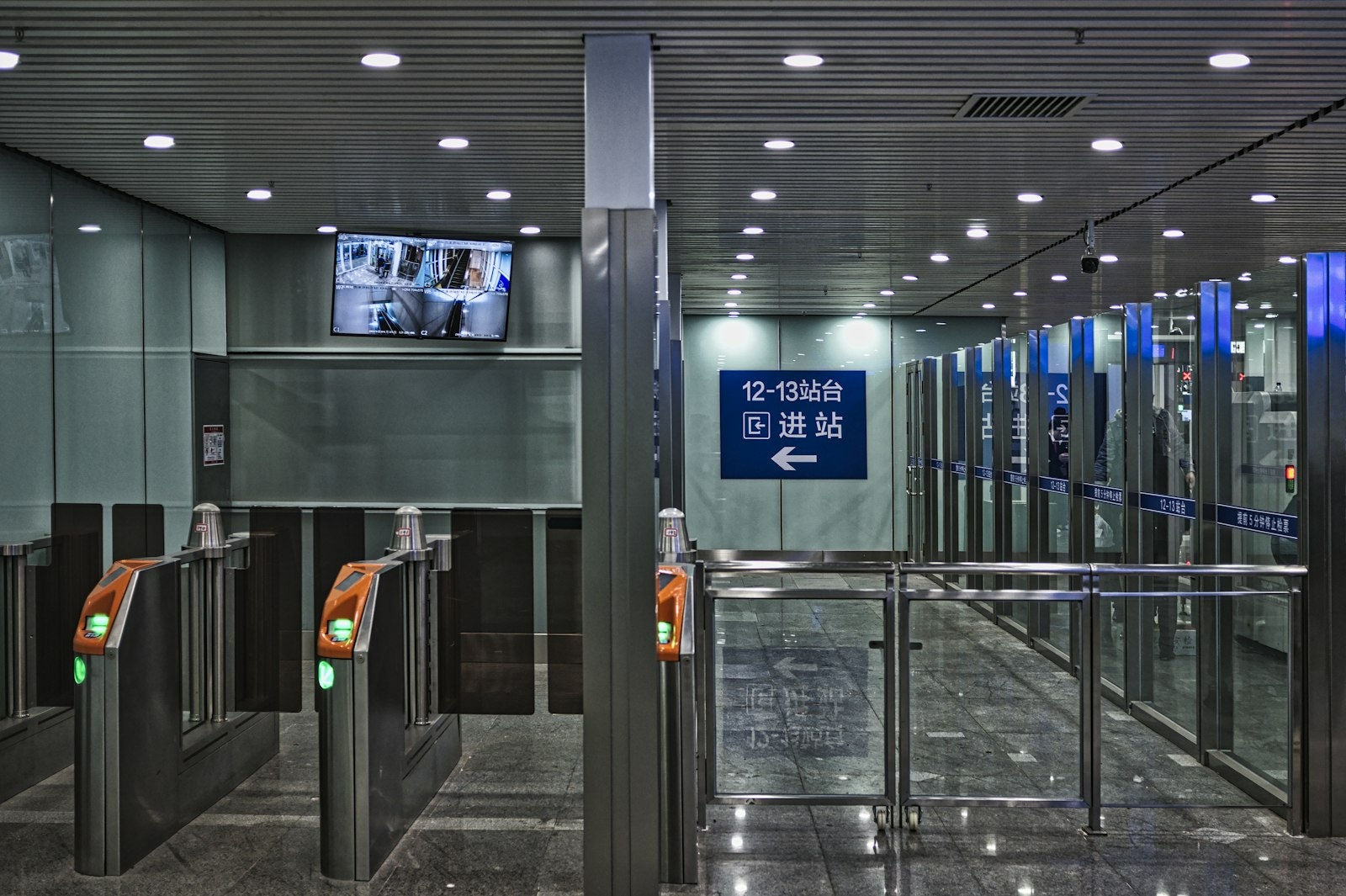
HPT's listing names corrections facilities, passenger stations, and gymnasiums as reference deployments, and the same lane logic applies to staff entrances at factories, warehouses, offices, and distribution centers. For supervised lobbies, HPT's pedestrian turnstile gate range pairs the same credential options with speed gates, swing gates, flap barriers, and tripod turnstiles, so verification can roll out door by door; the industries overview maps the hardware to sector requirements.
Buyer Problem
Buyers move to face recognition access control when these costs become visible.
Shared and loaned credentials. RFID and IC cards identify the card, not the bearer. Supervisors lend badges, contractors keep expired ones, and tailgaters walk in behind a valid holder. Face verification removes the transferable token from the equation.
Credential administration overhead. Every lost card, new hire, and contractor rotation means issuing, recovering, and auditing physical media. Facial enrollment replaces media logistics with a one-time enrollment per person, and the listed counting function gives a passage count to reconcile against verification events.
Contactless throughput. The listed 0.2s reaction time and 30p/m free-flow throughput mean a verified person passes without stopping to present a card — a real difference at shift changes and event entries.
Fragmented projects. Integrators and retailers increasingly need biometric lanes, conventional turnstiles, and vehicle access under one purchase order. HPT is a factory-direct manufacturer spanning pedestrian turnstiles and vehicle systems (barrier gates, LPR/ANPR, RFID vehicle access), with API integration, OEM/ODM, installation guidance, and technical support as listed services. The low listed MOQ and lead times of 7 days for 1-10 pieces and 20 days for 11-200 pieces make a pilot lane a small, fast order.
Selection Criteria
Evaluate any face recognition access control proposal against the following points.
Credential mix and multi-mode support
HPT's lane lists six access control types: face recognition, fingerprint, RFID card, IC card, QR code, and ESD system — the last covering static-controlled entry at electronics-plant doors. That range lets one lane serve staff on face, visitors on QR codes, and contractors on cards. If your policy requires credential combinations, for example card plus face in restricted zones, confirm in writing which sequences the configuration supports.
Lane performance and throughput
Listed figures: 0.2s reaction time, 0.2s barrier open/close, 30p/m (persons per minute) throughput, 660mm passage width, bi-directional passage, and LED indication. Treat 30p/m as the free-flow maximum — real-world rates depend on how quickly people present to the camera and on capture-point lighting. Size lane count against your measured peak, not your daily average.
Build, drive, and siting
The cabinet is 304 stainless steel with a silver finish, a listed product size of 140023002300mm, a listed unit size of 240X160X240, and a listed unit weight of 150.0; drive options are semi-automatic or full-automatic. Confirm which product-size figure is height, width, and depth against your mounting layout. For outdoor entrances, require a stated sealing rating in writing — the listing publishes no ingress-protection figure.
Biometric data governance
Face templates are regulated personal data in many markets, and requirements differ by jurisdiction. Before award, get written answers on where templates are stored (on-device, on-server, or both), how they are protected in storage and transit, retention and deletion processes, and required enrollment consent and signage. Involve your compliance advisor early — retrofitting privacy controls after go-live costs far more than specifying them.
Integration and protocols
The listed interfaces are RS-232, RS485, and TCP/IP. If your access management platform or visitor system needs event-level data or remote enrollment, agree the scope during quotation; API integration is a listed HPT service, and fixing protocol expectations early keeps commissioning on schedule.
Technical Proof
The table below reproduces the manufacturer's listed data for the turnstile-integrated face recognition configuration.
- Parameter · Listed value
- Model / brand · AG-PX48141402 / HPT
- Manufacturer · Shenzhen Hpt Intelligent Technology Co., Ltd., Guangdong, China
- Category · Face recognition (turnstile-integrated)
- Material / finish · 304 stainless steel / silver
- Product size · 140023002300mm (as listed)
- Unit size · 240X160X240 (as listed)
- Unit weight · 150.0 (as listed)
- Passage width · 660mm
- Passage direction · Bi-directional, 2-way
- Throughput rate · 30p/m
- Reaction time · 0.2s
- Barrier open/close time · 0.2 s
- Access control types · Face recognition, fingerprint, RFID card, IC card, QR code, ESD system
- Peripheral · Face recognition module
- Interfaces · RS-232, RS485, TCP/IP
- Indication · LED
- Safety functions · Anti-pinch, anti-tailgating, collision avoidance, counting
- Drive · Semi-automatic / full-automatic
- Incoterm / lead time · FOB; 1-10 pieces: 7; 11-200 pieces: 20
- Price · $900-1,300 / piece
The manufacturer holds ISO9001 (quality management), ISO14001 (environmental management), OHSAS18001 (occupational health and safety), CE and FCC conformity, China's CCC and CQC marks, National High and New Technical Enterprise status, SRDI enterprise certification, Guangdong Province Trustworthy Enterprise recognition, an IP management system certification, and Dun & Bradstreet registration 637941335. Request scanned certificates against each claim and match the holder name to the contracting entity.
One gap belongs in every biometric evaluation: the listing publishes no matching-accuracy figures (false-accept or false-reject rates), no liveness or anti-spoofing capability statement, and no template-storage architecture. These are decision-critical numbers, so require them in writing, with test conditions, during evaluation rather than after delivery.
Risks and Mistakes
Judging by a showroom demo. Demo benches are lit like studios; your entrance is not. Evaluate the lane at your own door, under your real backlighting and night conditions, before a fleet order.
Not requiring accuracy and liveness figures in writing. No accuracy or anti-spoofing figures appear in the listing. Make stated false-accept/false-reject rates and liveness provisions an award condition, with test conditions attached.
Treating biometrics as a card replacement only. On an open lobby door, a confident verification followed by two tailgaters achieves nothing. Pair face verification with hardware that enforces one person per passage — the full-height rotor in this configuration exists for that reason.
Ignoring biometric privacy compliance. Regulations covering facial data differ by market and change frequently. Confirm the legal basis, retention limits, and signage with your compliance advisor for every deployment country before hardware ships.
Underestimating enrollment logistics. Ask how templates are enrolled at scale — at the device, via software, or via API — and who administers deletion when someone leaves. Enrollment is where biometric projects lose their first week.
Skipping warranty and spares terms. Warranty details are not published in the listing. Get duration, the coverage split between barrier mechanics and recognition module, spare-part availability, and firmware support into the contract.
FAQ
Which credentials does the lane support besides face recognition?
Fingerprint, RFID card, IC card, QR code, and ESD system are listed alongside face recognition, so one lane can serve mixed populations.
What are the price and lead times?
The listed price is $900-1,300 per piece FOB, with lead times of 7 days for 1-10 pieces and 20 days for 11-200 pieces.
Can it integrate with an existing access control system?
RS-232, RS485, and TCP/IP are listed, and API integration is a listed manufacturer service. Confirm protocol mapping to your platform during quotation.
What certifications does the manufacturer hold?
ISO9001, ISO14001, OHSAS18001, CE, FCC, CCC, and CQC, plus National High and New Technical Enterprise status, SRDI enterprise certification, and Dun & Bradstreet registration 637941335.
Next Step
The lowest-risk entry point is a pilot lane: with a low listed MOQ and the 7-day lead time on small orders, install one lane at your most problem-prone door, measure real verification rates and enrollment effort on your own population, and let the results justify the rollout. Request a sample through HPT's contact page, and include your site type, expected user count, credential mix, and access control platform so the first quotation matches the right configuration.
When you submit the request, also ask for the face recognition access control procurement checklist. It converts the confirmation items above — accuracy and liveness figures, template storage and deletion, sealing rating, warranty terms, and pre-shipment tests — into an RFQ line list that makes quotes from any supplier comparable. Shenzhen Hpt Intelligent Technology Co., Ltd. is a factory-direct ISO9001/ISO14001 certified manufacturer of integrated pedestrian and vehicle access control, so the pilot lane, the production fleet, and vehicle-side hardware can come from one supply base with a single support contact.